
How to Fix Hard Soil Compacted Farmland, Improve Soil Structure and Regenerate Soil For Crop Yield Increase
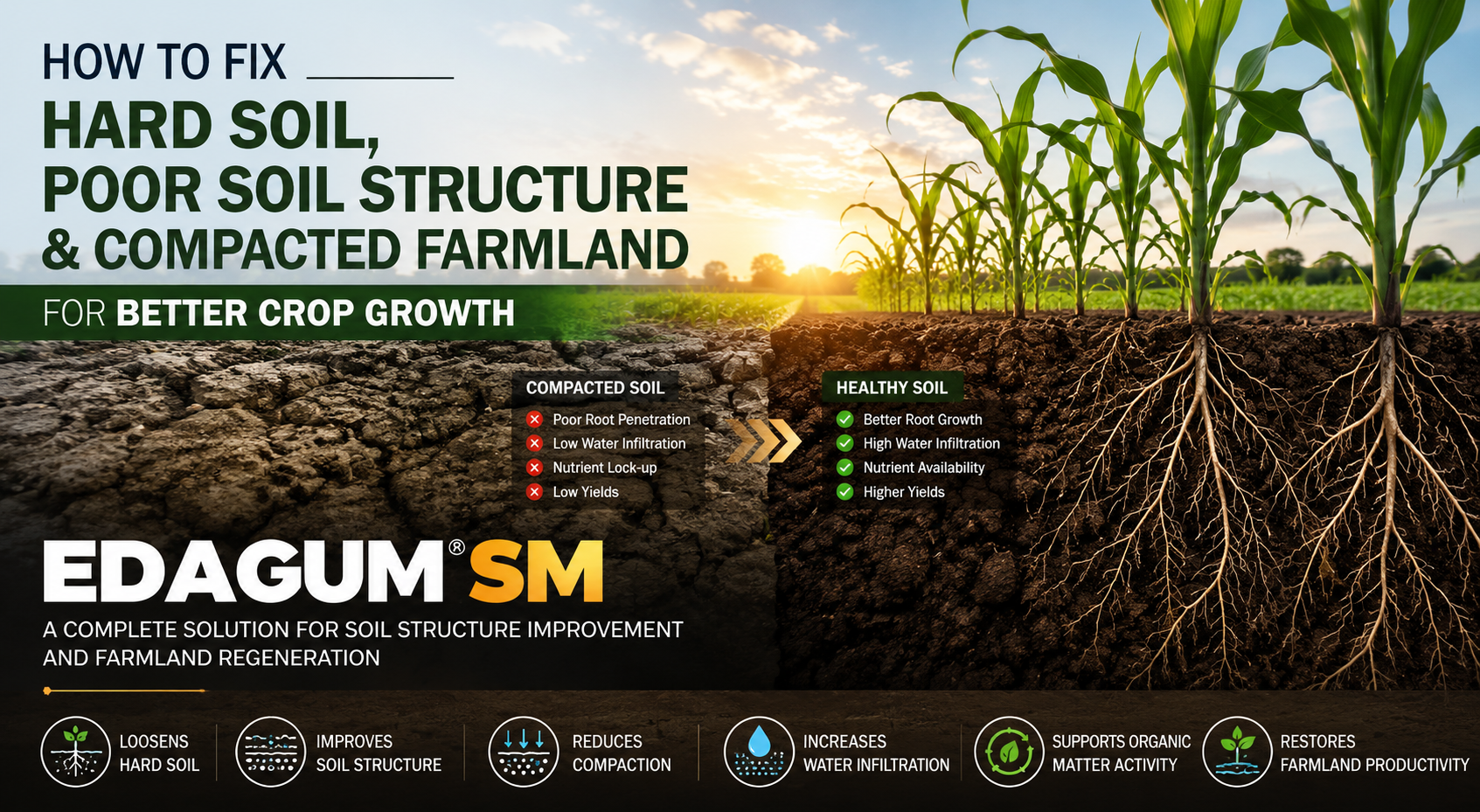
Hard, compacted soil is one of the most common and costly problems farmers face, often leading to poor root development, reduced water infiltration, limited nutrient availability, and ultimately lower crop yields. When soil structure breaks down due to heavy machinery, poor organic matter levels, or long-term overworking of the land, plants struggle to grow efficiently even when fertilizer and irrigation are applied. The good news is that soil compaction and poor structure can be improved with the right combination of biological activity, organic matter restoration, and targeted soil conditioning practices. In this article, we’ll explore practical and science-based solutions to help restore healthy soil structure, improve aeration and drainage, and create a productive growing environment for stronger, more resilient crops.
Why Hard Soil in Soil Degradation Is Reducing Crop Yield
Across many farming regions, soil productivity is declining not because of reduced fertilizer use, but because of physical soil degradation.
Fields that once produced strong, uniform crops are now showing:
- Hard, dense soil layers
- Poor root penetration
- Water pooling after rain
- Uneven crop emergence
- Declining yield even with higher fertilizer inputs
These are classic signs of compacted and structurally degraded soil. When soil becomes physically restrictive, plants cannot fully access water, oxygen, and nutrients—even if those nutrients are present in the soil.
Fixing hard soil requires more than fertilization. It requires restoring soil structure, porosity, and root-zone conditions.
How to Restore Soil Structure and Fix Poor Soil Fertility When Fertilizer Is No Longer Working
Many farmers notice a frustrating pattern: fertilizer inputs increase each year, but yields continue to decline or plateau. This is often not a fertilizer problem—it is a soil access problem.
When soil becomes compacted or structurally weak:
- Nutrients remain locked in the soil profile
- Roots cannot reach deeper nutrient zones
- Water movement becomes restricted
- Plant stress increases during dry or wet conditions
Common signs include:
- Weak crop vigor
- Uneven plant height across the field
- Nutrient deficiency symptoms despite fertilization
- Lower-than-expected yield response
Before increasing fertilizer rates, it is essential to evaluate whether soil structure is limiting plant performance.
Compacted Soil Treatment For Better Root Penetration
Soil compaction is one of the most common hidden causes of yield loss in modern agriculture. Compaction typically develops from:
- Repeated heavy machinery traffic
- Working soil under wet conditions
- Long-term intensive cultivation
- Lack of deep root channels or organic structure
When soil becomes compacted:
- Roots are forced to grow sideways instead of downward
- Water infiltration slows significantly
- Oxygen availability in the root zone decreases
- Nutrient uptake efficiency declines
This creates a root-limiting layer that reduces plant performance even in well-fertilized fields.
Key correction goal:
Restore soil porosity so roots can penetrate deeper and access moisture and nutrients more effectively.
How to Improve Soil Structure Naturally for Better Water Infiltration
Improving soil structure starts with physically relieving soil compaction and creating better conditions for roots, water, and beneficial soil life. Farmers can use several practical approaches to loosen hard soil and restore healthy soil structure.
Loosen Compacted Soil with Deep Tillage or Subsoiling
When soil becomes severely compacted, deep tillage or subsoiling can help break up hardpan layers that restrict root growth and water movement. By creating channels through compacted zones, water can infiltrate more easily and roots can explore deeper soil layers. However, tillage should be used strategically, as excessive tillage can eventually damage soil structure and organic matter levels.
Reduce Equipment Traffic and Avoid Working Wet Fields
Heavy machinery operating on wet soil is one of the primary causes of soil compaction. Limiting field traffic, reducing axle loads, and avoiding field operations when soils are saturated can prevent further compaction and help preserve existing soil structure.
Increase Organic Matter Inputs
Adding compost, manure, crop residues, or other organic materials helps bind soil particles into stable aggregates. Organic matter improves soil porosity, water-holding capacity, and resistance to compaction while providing food for beneficial soil organisms.
Plant Cover Crops with Strong Root Systems
Cover crops such as tillage radish, rye, oats, and clover help naturally loosen soil through root penetration. Their roots create channels that improve water infiltration and aeration while adding valuable organic matter to the soil profile.
Encourage Earthworms and Beneficial Soil Biology
Healthy soils contain billions of microorganisms along with earthworms and beneficial fungi that naturally build soil structure. Their activity creates stable aggregates and pore spaces that improve water movement, nutrient cycling, and root development.
Minimize Excessive Tillage
While deep tillage may be useful for correcting severe compaction, repeated intensive tillage can destroy soil aggregates and accelerate organic matter loss. Conservation tillage practices help preserve the natural structure created by roots and soil organisms.
Soil structure refers to how soil particles bind together to form aggregates and pore spaces. Healthy structure allows:
- Fast water infiltration
- Proper drainage after rainfall
- Good air exchange in the root zone
- Uniform crop emergence
Poor soil structure leads to:
- Surface crusting after rain
- Water ponding in low areas
- Slow infiltration and runoff
- Patchy germination
Improving soil structure helps the soil behave like a living sponge system, absorbing and distributing water evenly throughout the profile. Over time, better structure reduces erosion and improves field trafficability.
Use Biological Soil Conditioners to Accelerate Soil Regeneration
Physical practices can loosen compacted soil, but long-term soil improvement requires rebuilding soil biology and aggregate stability. Biological soil conditioners such as EDAGUM®SM help stimulate microbial activity, improve soil aggregation, increase pore space, and enhance water infiltration. When combined with good agronomic practices, these technologies can accelerate soil regeneration and help maintain healthy soil structure over the long term.
By combining mechanical compaction relief, improved field management, organic matter additions, cover crops, and biological soil-conditioning technologies, farmers can transform hard, compacted soil into a productive growing environment that supports stronger root systems, better water management, and higher crop yields.
Increase Soil Organic Matter Naturally to Build Better Farmland
Organic matter is a critical component of long-term soil stability and physical performance.
It plays a direct role in:
- Binding soil particles into stable aggregates
- Improving soil texture and tilth
- Increasing moisture retention
- Enhancing nutrient retention capacity
- Reducing soil hardness over time
Fields with low organic matter typically become:
- Harder to till
- More prone to compaction
- Less responsive to fertilizers
- More vulnerable to drought stress
Rebuilding organic matter is essential for restoring long-term soil productivity and improving physical soil behavior.
Best Soil Conditioner for Agriculture and Long-Term Soil Improvement
Many soil problems share a common root cause: loss of soil structure integrity. A high-performance soil conditioner is designed to address this by improving the physical condition of the soil profile. An effective soil conditioner can help:
- Loosen compacted soil layers
- Improve aggregation and particle bonding
- Enhance water holding capacity
- Increase root penetration depth
- Improve field workability
Unlike short-term fixes, soil conditioning focuses on long-term structural restoration, not temporary nutrient correction.
Soil Regeneration for Farmland After Years of Intensive Cropping
Years of continuous cultivation can gradually degrade soil physical quality. Common long-term symptoms include:
- Increasing soil hardness
- Reduced tilth and friability
- Declining infiltration rates
- Lower organic matter levels
- Higher input costs to maintain yield
Soil regeneration focuses on reversing these trends by restoring:
- Soil looseness
- Aggregate stability
- Water movement efficiency
- Root-zone accessibility
The goal is to return farmland to a condition where it can support consistent crop production with lower stress and improved efficiency.
Soil Health Improvement Products That Help Restore Productive Farmland
Modern agriculture increasingly uses soil improvement technologies to address structural degradation issues that cannot be solved by fertilizers alone. The goal is not just nutrient supply—but rebuilding the physical functionality of soil.
Healthy, well-structured soil provides:
- Strong root development
- Better nutrient accessibility
- Improved water management
- Higher drought resilience
- More stable crop performance
Soil improvement products are most effective when integrated into a broader strategy that focuses on rebuilding long-term soil structure and productivity.
EDAGUM®SM – A Complete Solution for Soil Structure Improvement and Soil Regeneration
Many farmland productivity challenges begin with one core issue: compacted, structurally weak soil.
EDAGUM®SM is designed to support long-term soil physical improvement by helping to:
- Loosen hard soil layers
- Improve soil aggregation and structure
- Reduce compaction effects in the root zone
- Increase water infiltration capacity
- Support long-term organic matter function
- Restore overall farmland productivity
Unlike short-term fertilizers that only supply nutrients, EDAGUM®SM focuses on rebuilding soil structure and improving root-zone conditions, which are essential for sustainable crop performance.
Learn more about NuviaTec EDAGUM®SM-Soil Treatment Additive, Soil Amending Bio Fertilizer and Soil Conditioner / Soil Regenerator.
- Learn more about How to Increase Crop Yield Naturally.
- Learn more about How Silicon Fertilizer Increases Crop Yield.
- Learn more about How to Improve Soil Health Naturally.
- Learn more about How to Improve Plant Nutrient Efficiency Naturally.
- Learn more about How to Fix Hard Soil Compacted Farmland and Regenerate Soil.
- Learn more about The Secret to Increasing Crop Yields: Stronger Roots and better crop stress resistance
NuviaTec Biological Products Certifications





Ready To Fix Compacted Farmland and Regenerate Soil For Crop Yield Boost?
Hard soil, poor soil structure, low water infiltration, and soil compaction can quietly reduce crop performance year after year. If fertilizer applications are no longer delivering the results they once did, the underlying problem may be deteriorating soil structure rather than nutrient supply alone.
EDAGUM®SM is designed to help farmers restore productive soil conditions by improving soil structure, reducing compaction, enhancing water infiltration, and supporting long-term farmland regeneration. By creating a healthier root-zone environment, EDAGUM®SM helps crops access water and nutrients more efficiently, resulting in stronger root development, improved crop vigor, and higher yield potential.
Whether you are managing row crops, specialty crops, orchards, or vegetable production, investing in soil improvement today can help build a more productive and resilient farm for the future.
Contact Nuviatec Technologies today to learn how EDAGUM®SM can help improve your soil structure, regenerate farmland, and maximize crop yield potential.
- [Contact Our Agronomy Team]
- [View Field Trial Results]
- [Explore Soil Regeneration Solutions]
- [Request Samples / Inquiry Form]
Contact Us
By phone: (416) 900-3768
By email: info@nuviachem.com