
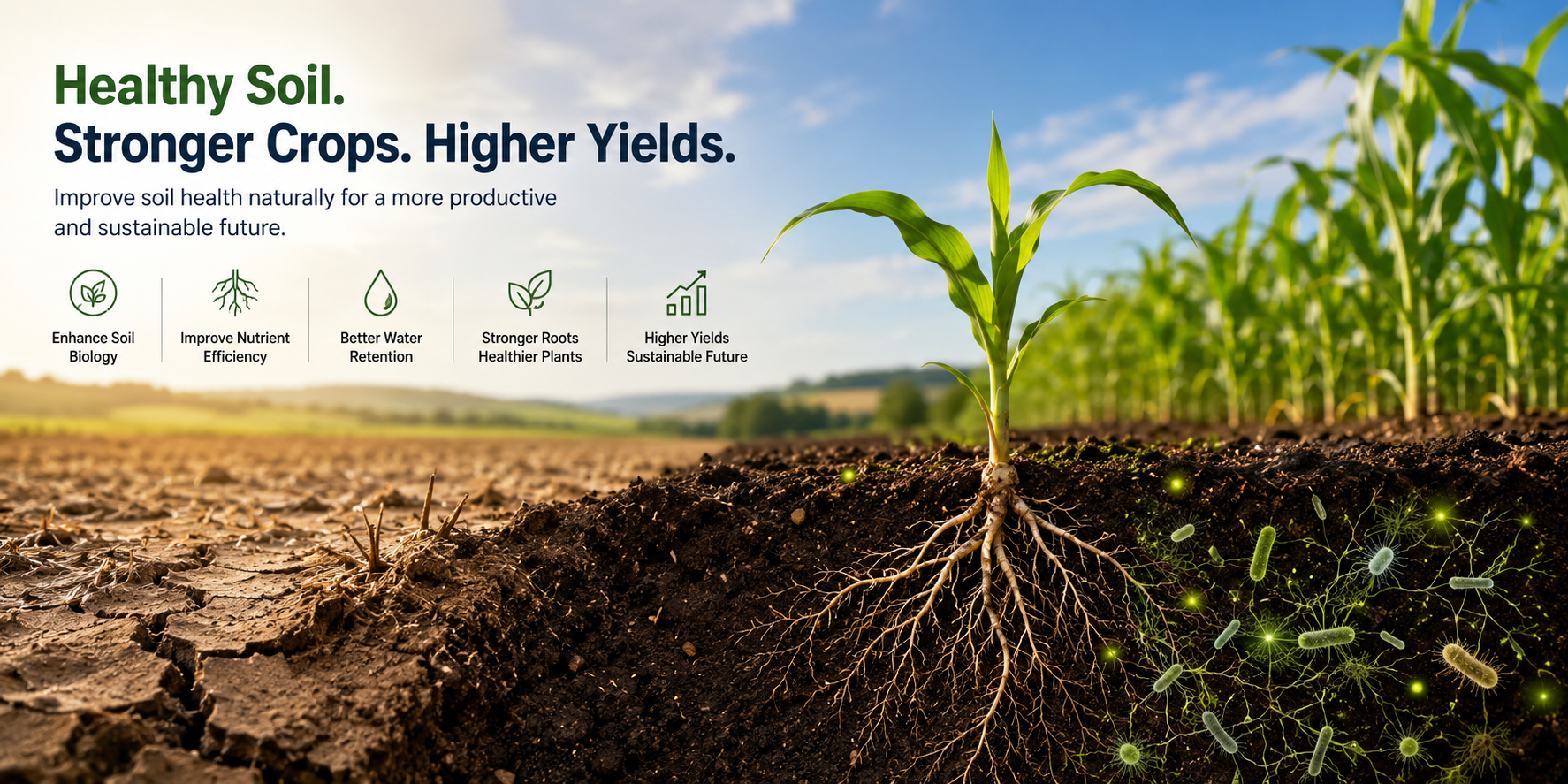
Soil Health Improvement For Higher Crop Yields
Healthy Soil Is the Foundation of Sustainable and Profitable Agriculture
Healthy soil is much more than a growing medium for crops. It is a living ecosystem where billions of beneficial microorganisms interact with plant roots, organic matter, water and nutrients to support vigorous plant growth. When soil is biologically active and structurally healthy, crops develop stronger root systems, absorb nutrients more efficiently, tolerate environmental stress more effectively and consistently produce higher yields.
Unfortunately, decades of intensive cultivation, excessive tillage, nutrient imbalance and declining organic matter have degraded agricultural soils around the world. Many growers experience declining yields despite increasing fertilizer inputs because degraded soils are no longer functioning efficiently as living ecosystems.
Improving soil health is therefore one of the most effective long-term strategies for increasing crop productivity, improving nutrient efficiency and building resilient farming systems. By restoring biological activity, enhancing soil structure and supporting beneficial microorganisms, growers can regenerate healthier soils that continue to perform season after season.
This comprehensive guide explains the science behind soil health improvement, the causes of soil degradation, proven practices for soil regeneration and how advanced biotechnology solutions such as EDAGUM® SM Advanced Soil Regenerator Biofertilizer can help restore healthy, productive soils naturally.
What Is Soil Health and Why Does It Matter?
Soil health refers to the continued capacity of soil to function as a living ecosystem that supports plant growth, nutrient cycling, water regulation and biological diversity. Healthy soil contains an active community of bacteria, fungi, actinomycetes, protozoa, earthworms and many other organisms that continuously recycle nutrients and improve soil structure.
A healthy agricultural soil performs many essential functions simultaneously. It stores and supplies nutrients, improves water infiltration and retention, supports extensive root development, suppresses certain soil-borne diseases and buffers crops against drought and environmental stress. These natural biological processes reduce dependence on synthetic inputs while improving overall crop performance.
By contrast, unhealthy soils often become compacted, biologically inactive and less efficient at supplying nutrients. Crops growing in degraded soils may require more fertilizer and irrigation while producing lower yields and becoming increasingly vulnerable to pests, diseases and climate variability.
For growers seeking long-term profitability, investing in soil health is one of the highest-return agricultural decisions because healthy soils continuously improve the efficiency of every production input applied to the field.
Key Characteristics of Healthy Agricultural Soils
Healthy soils typically exhibit the following characteristics:
- High biological activity with abundant beneficial microorganisms.
- Stable soil structure that promotes aeration and root penetration.
- Adequate organic matter to support microbial populations.
- Efficient nutrient cycling and nutrient availability.
- Improved water infiltration and water holding capacity.
- Active root development throughout the growing season.
- Greater resistance to erosion and soil compaction.
- Increased resilience under drought and environmental stress.
- Consistent crop performance and improved yield potential.
Common Causes of Soil Degradation
Soil degradation is a gradual process that reduces the biological, physical and chemical quality of agricultural land. Although fertilizers can temporarily replace nutrients removed by crops, they cannot fully restore the living biological systems that healthy soils depend upon.
Modern agricultural practices have greatly increased food production, but continuous cropping without adequate biological restoration has also accelerated the decline of soil health in many farming regions.
Several major factors contribute to soil degradation:
MajorFfactors Contribute To Soil Degradation
Intensive Continuous Cropping
Growing crops season after season without sufficient biological recovery gradually depletes soil organic matter, reduces microbial diversity and weakens the soil ecosystem.
Declining Organic Matter
Organic matter serves as the primary food source for beneficial soil microorganisms. As organic matter decreases, microbial populations decline, nutrient cycling slows and soil structure deteriorates.
Soil Compaction
Heavy machinery and repeated field traffic compress soil particles, reducing pore space, limiting oxygen availability and restricting root growth. Compacted soils also reduce water infiltration and microbial activity.
Nutrient Imbalance
Applying nutrients without considering biological nutrient cycling may create imbalances that limit nutrient availability to plants, even when fertilizers are present in the soil.
Loss of Beneficial Soil Microorganisms
Beneficial bacteria and fungi play essential roles in nutrient cycling, disease suppression and soil aggregation. Declining microbial diversity weakens the soil’s natural ability to support healthy crop growth.
These factors often interact with one another, creating a cycle of declining soil productivity. Breaking this cycle requires more than simply adding fertilizer—it requires rebuilding the biological foundation of healthy soil.
How Soil Microorganisms Drive Soil Health Improvement and Plant Growth
Soil health improvement is fundamentally a biological process driven by microorganisms. Beneath every productive field exists a complex ecosystem of bacteria, fungi, protozoa, and actinomycetes that regulate nutrient cycling, organic matter decomposition, and plant-root interactions.
These microorganisms form a living network that transforms soil from an inert medium into a dynamic biological system. When microbial populations are diverse and active, soil becomes more efficient at supporting plant growth and maintaining long-term fertility.
Healthy soil microbiology improves plant performance in several key ways:
Nutrient Cycling and Natural Fertility Release
Microorganisms break down organic matter and mineral compounds, converting nutrients into plant-available forms. This biological nutrient cycling reduces nutrient losses and improves fertilizer efficiency.
Rhizosphere Interactions and Root Symbiosis
The rhizosphere—the soil zone around plant roots—is one of the most biologically active regions in agriculture. Beneficial microbes colonize this zone, forming symbiotic relationships with plant roots that enhance nutrient uptake and stimulate root growth.
Disease Suppression and Soil Resilience
A biologically diverse soil ecosystem helps suppress harmful pathogens by competing for resources and producing natural antimicrobial compounds. This reduces disease pressure and improves crop stability.
Soil Aggregation and Structure Formation
Microbial byproducts such as polysaccharides help bind soil particles together, improving soil aggregation. This enhances aeration, water infiltration, and root penetration.
Soil Organic Matter and Soil Health Improvement in Agricultural Systems
Soil organic matter is one of the most important indicators of soil health. It serves as the primary energy source for soil microorganisms and plays a central role in nutrient retention, water holding capacity, and soil structure stability.
When organic matter levels decline, soil becomes biologically inactive and less efficient at supporting crop growth.
Organic Matter as a Biological Energy Source
Organic matter feeds soil microorganisms, supporting a continuous cycle of decomposition and nutrient release. Without sufficient organic matter, microbial populations decline and soil functions weaken.
Carbon Storage and Long-Term Soil Fertility
Healthy soils act as carbon sinks, storing organic carbon that improves soil structure and nutrient retention. This carbon also supports long-term fertility and resilience.
Water Retention and Drought Resistance
Organic matter increases the soil’s ability to retain water, improving plant resilience during dry conditions and reducing irrigation requirements.
Nutrient Efficiency and Soil Health Improvement in Modern Farming
Nutrient efficiency is directly linked to soil health. Even when fertilizers are applied, crops cannot fully utilize nutrients if soil biology and structure are degraded. Improving soil health enhances nutrient efficiency by optimizing the way nutrients move through the soil-plant system.
Improved Fertilizer Utilization
Healthy soils reduce nutrient leaching and volatilization, ensuring that more applied nutrients are absorbed by plant roots.
Enhanced Root Nutrient Uptake
Strong root systems supported by microbial activity can access nutrients more effectively across larger soil volumes.
Biological Nutrient Availability
Soil microorganisms convert locked nutrients into plant-accessible forms, improving overall nutrient availability without increasing fertilizer inputs.
Soil Structure Improvement and Water Management
in Soil Health Systems
Soil structure determines how air, water, and roots move through the soil. Poor structure leads to compaction, poor drainage, and restricted root development. Improving soil structure is a key component of soil health improvement.
Soil Aggregation and Porosity Development
Microbial activity improves soil aggregation, creating pore spaces that allow oxygen, water, and roots to move freely.
Reduced Soil Compaction and Hardpan Formation
Biologically active soils resist compaction better than degraded soils, reducing the formation of hard layers that restrict root growth.
Water Infiltration and Drainage Balance
Healthy soils absorb water more efficiently, reducing runoff and improving water distribution throughout the root zone.
Regenerative Agriculture and Long-Term Soil Health Improvement Practices
Regenerative agriculture focuses on restoring soil health rather than simply maintaining productivity. It integrates biological, physical, and ecological processes to rebuild soil function over time.
Cover Cropping and Continuous Soil Coverage
Cover crops protect soil from erosion, enhance organic matter, and support microbial diversity during off-seasons.
Reduced Tillage and Soil Disturbance
Minimizing soil disturbance preserves microbial habitats and maintains soil structure integrity.
Organic and Biological Inputs
Compost, biofertilizers, and microbial inoculants support long-term soil regeneration by restoring biological activity.
Crop Rotation and Biodiversity Enhancement
Diverse cropping systems improve soil microbial diversity and reduce disease cycles.
Advanced Biotechnology for Soil Health Improvement and Soil Regeneration
While regenerative farming practices provide the foundation for soil restoration, advanced biotechnology can significantly accelerate the soil regeneration process.
Biological soil amendments containing beneficial microbial consortia help reintroduce functional microbial populations into degraded soils, restoring biological balance and improving soil performance more rapidly. In practical agricultural applications, these principles of soil microbiology and microbial enhancement are now being translated into targeted biological solutions designed for real field conditions.
EDAGUM®SM is an advanced bio soil conditioner and biofertilizer developed to apply these principles of agricultural biotechnology in practical field conditions, supporting accelerated soil regeneration, improved microbial activity, and enhanced soil fertility in modern farming systems.
EDAGUM® SM Advanced Soil Regenerator Biofertilizer
EDAGUM® SM is an advanced soil regeneration technology designed to restore soil biological activity, improve nutrient cycling, and enhance soil structure through beneficial microbial processes. It supports soil health improvement by:
- Enhancing microbial population diversity
- Stimulating nutrient cycling processes
- Improving organic matter decomposition
- Supporting root development and rhizosphere activity
- Increasing nutrient availability to crops
- Improving soil aggregation and structure formation
By reactivating soil biology, EDAGUM® SM helps restore degraded soils into productive, living ecosystems capable of sustaining higher crop yields.
How EDAGUM® SM Supports Soil Health Improvement in the Field
Once applied to soil, beneficial microorganisms begin interacting with native soil biology. Over time, these interactions improve nutrient availability, enhance soil structure, and restore biological balance.
This biological activation process contributes to:
- Stronger and deeper root systems
- Improved nutrient uptake efficiency
- Greater drought resistance
- Enhanced crop vigor and uniformity
- Improved long-term soil productivity
Field Performance and Soil Health Improvement Outcomes by EDAGUM®SM
Field performance results from biologically improved soils show that the use of EDAGUM®SM bio soil conditioner and biofertilizer consistently contributes to measurable improvements in soil health, soil fertility, and crop productivity under real farming conditions.
Across a wide range of field trials, agronomic studies, and commercial farming applications, soils treated with EDAGUM®SM typically demonstrate:
- Improved soil structure, aggregation, and friability
- Enhanced root system development and deeper root penetration
- Increased nutrient use efficiency and fertilizer effectiveness
- More uniform crop growth, vigor, and plant health
- Greater yield stability under drought, heat, and other stress conditions
These improvements are not the result of a single fertilizer input, but the outcome of restored soil biological activity and improved soil microbiology function over time. EDAGUM®SM works as a soil regeneration solution by stimulating beneficial microbial activity, enhancing nutrient cycling, and rebuilding long-term soil fertility.
Importantly, EDAGUM®SM has been tested in multiple field trials and real agricultural farming environments, where it has demonstrated consistent and repeatable results in improving soil biological function and supporting higher crop performance. These results confirm that EDAGUM®SM is a proven bio soil conditioner and biofertilizer for modern regenerative agriculture, rather than a theoretical or laboratory-based concept.
By improving soil microbial balance and enhancing natural soil processes, EDAGUM®SM supports sustainable soil regeneration, soil health restoration, and long-term crop yield improvement across diverse agricultural systems.
Conclusion: EDAGUM®SM is a proven, field-tested solution for soil health improvement, soil regeneration, and sustainable crop yield enhancement in modern farming systems.
To explore documented field trials, agronomic studies, and proven crop performance results, visit our Field Test Centre:
https://nuviatec.com/proven-crop-results-field-trials-agronomy-studies/
Soil Health Improvement for Higher Crop Yields:
The Integrated Approach
The most effective soil health strategies combine biological, physical, and management practices into one integrated system. A successful soil health improvement strategy includes:
- Restoring microbial activity
- Increasing soil organic matter
- Improving nutrient cycling efficiency
- Enhancing soil structure
- Supporting sustainable agronomic practices
- Applying targeted biological solutions like EDAGUM® SM
When these elements work together, soil transitions from a degraded state into a productive, self-regulating biological system.
Frequently Asked Questions About Soil Health Improvement
What is soil health improvement?
Soil health improvement refers to enhancing the biological, physical, and chemical properties of soil to support better plant growth and long-term productivity.
How can I improve soil health naturally?
Soil health can be improved through organic matter addition, microbial activity enhancement, reduced tillage, crop rotation, and biological soil amendments.
What causes poor soil health?
Common causes include intensive farming, low organic matter, soil compaction, and loss of beneficial microorganisms.
How long does soil regeneration take?
Depending on soil condition, improvements may begin within one season but full regeneration typically requires multiple growing cycles.
What is the role of microorganisms in soil health?
Microorganisms drive nutrient cycling, organic matter decomposition, and soil structure formation, making them essential for soil health.
Improve Soil Health Naturally with Biological Soil Regeneration Technologies
Modern agriculture increasingly relies on biological solutions to restore soil productivity. Advanced microbial technologies help accelerate natural soil regeneration processes by reintroducing beneficial organisms and restoring biological balance.
These approaches support long-term sustainability while improving crop productivity and resource efficiency.
Soil Health Improvement Starts with Action
Improving soil health is one of the most effective ways to increase crop yield, reduce input costs, and build resilient agricultural systems.
Whether through regenerative farming practices or advanced biological solutions, restoring soil health creates long-term value for growers and the environment.
For degraded or low-performing soils, biological regeneration technologies such as EDAGUM® SM can play a key role in accelerating recovery and restoring productivity.




Ready to Improve Soil Health Naturally?
Discover how EDAGUM®SM and NuViaTec biological soil technologies can help regenerate soil health, improve nutrient efficiency, and support sustainable crop production.
[Contact Our Agronomy Team]
[View Field Trial Results]
[Explore Soil Regeneration Solutions]
[Request Samples / Inquiry Form]
Contact Us
By phone: (416) 900-3768
By email: info@nuviachem.com


