
Stop Wasting Fertilizer: How to Improve Plant Nutrient Efficiency Naturally and Boost Crop Yield
Every growing season, farmers invest significant money in fertilizer to maximize crop performance and profitability. However, many crops utilize only a portion of the nutrients applied. The remaining nutrients may become locked in the soil, leach below the root zone, or be lost to the environment.
This means that simply applying more fertilizer does not always result in higher yields. The key to improving farm profitability is not necessarily applying more nutrients, but helping crops use nutrients more efficiently. This is where nutrient efficiency becomes critically important.
Improving nutrient efficiency allows farmers to:
- Get more value from fertilizer investments
- Increase crop yield potential
- Improve soil health
- Reduce nutrient losses
- Lower overall production costs
- Build long-term farm sustainability
Let’s examine the factors that affect nutrient efficiency and the practical solutions available to today’s farmers.
Improve Crop Nutrient Efficiency and Get More Value from Every Fertilizer Application
Nutrient efficiency refers to how effectively crops absorb and utilize nutrients applied through fertilizers and soil amendments. Many growers experience situations where fertilizer costs continue to rise while crop response remains inconsistent.
Common causes include:
- Poor soil biology
- Soil compaction
- Low organic matter
- Weak root development
- Nutrient lock-up
- Environmental stress
Improving nutrient efficiency means ensuring that more nutrients remain available to crops and less fertilizer is wasted. When nutrient efficiency improves, farmers often see stronger crop performance, healthier plants, and better return on investment from fertilizer programs.
Increase Nutrient Uptake in Crops for Higher Yield and Stronger Plant Growth
Even when nutrients are present in the soil, plants cannot benefit unless those nutrients are absorbed through healthy root systems.
Poor nutrient uptake can lead to:
- Slow plant growth
- Reduced vigor
- Nutrient deficiencies
- Lower yields
Several factors influence nutrient uptake:
- Root health
- Soil moisture
- Soil biology
- Soil structure
- Environmental conditions
Improving nutrient uptake helps crops access the nutrients they need throughout the growing season, resulting in stronger plant development and increased yield potential.
Improve Soil Health and Unlock More Nutrients Already in Your Soil
Healthy soil acts as a living ecosystem that supports nutrient availability and plant growth. Many agricultural soils contain significant nutrient reserves that are unavailable to crops because they are chemically bound or biologically inactive.
Improving soil health helps:
- Increase microbial activity
- Enhance nutrient cycling
- Improve water retention
- Support root growth
- Release locked nutrients
Building healthy soil creates a foundation for long-term productivity while reducing dependence on excessive fertilizer applications.
Reduce Fertilizer Waste and Lower Crop
Production Costs
Fertilizer loss is one of the largest hidden expenses in agriculture.
Nutrients may be lost through:
- Leaching
- Runoff
- Volatilization
- Soil fixation
As fertilizer prices continue to rise, reducing nutrient loss becomes increasingly important. Farmers who improve nutrient retention within the root zone can often achieve better crop performance without increasing fertilizer application rates. This approach improves profitability while supporting more sustainable farming practices.
Improve Root Growth for Better Nutrient Absorption
Healthy roots are essential for efficient nutrient use.
A strong root system enables plants to:
- Access nutrients from a larger soil volume
- Absorb more water during dry conditions
- Recover more quickly from stress
- Maintain consistent growth
Poor soil conditions often limit root development and reduce nutrient absorption efficiency.
Supporting root growth creates the foundation for improved nutrient uptake and stronger crop performance throughout the season.
Beneficial Soil Microbes for Better Crop Nutrition Naturally
Beneficial soil microbes play a critical role in nutrient cycling and soil fertility.
These microorganisms help:
- Break down organic matter
- Release nutrients into plant-available forms
- Improve root health
- Support overall soil biology
Healthy microbial populations create a more efficient nutrient delivery system within the soil. By improving biological activity, farmers can often increase nutrient availability while reducing nutrient losses.
Increase Nitrogen Availability and Improve Fertilizer Efficiency
Nitrogen is one of the most important nutrients for crop growth, but it is also one of the most easily lost nutrients.
Nitrogen losses can occur through:
- Leaching
- Denitrification
- Volatilization
Improving nitrogen availability allows crops to utilize a greater percentage of applied fertilizer.
Better nitrogen efficiency often results in:
- Improved vegetative growth
- Increased chlorophyll production
- Enhanced yield potential
Plant Bio stimulants for Drought Stress, Heat Stress, and Yield Improvement
Environmental stresses can significantly reduce nutrient efficiency.
Common stress factors include:
- Drought
- Heat
- Salinity
- Temperature fluctuations
Under stress conditions, plants often reduce nutrient uptake and growth. Biostimulants can help support plant metabolism, improve stress tolerance, and maintain nutrient absorption during challenging growing conditions. As a result, crops are better equipped to maintain productivity when environmental pressures occur.
Regenerate Soil Fertility and Increase Organic Matter Naturally
Long-term farm productivity depends on healthy, fertile soil.
Years of intensive farming can contribute to:
- Reduced organic matter
- Soil compaction
- Lower microbial activity
- Declining fertility
Regenerating soil fertility helps restore biological function and improve nutrient cycling. Increasing organic matter can also improve water retention, nutrient retention, and overall soil resilience. Healthy soil is one of the most valuable assets a farmer can build.
Sustainable Crop Nutrition Programs for Higher Yield and Lower Input Costs
The future of profitable farming depends on producing more while using resources more efficiently.
A sustainable crop nutrition program focuses on:
- Soil health
- Nutrient efficiency
- Biological activity
- Stress management
- Long-term productivity
Rather than relying solely on additional fertilizer, successful growers increasingly adopt integrated solutions that improve nutrient utilization and support healthier soils.
Improve Crop Nutrient Efficiency Naturally with Nuviatec Solutions
Improving nutrient efficiency requires more than simply applying fertilizer. Nutrients must first become available in the soil, and then crops must be able to absorb, transport, and utilize those nutrients effectively.
This is why many fertility programs fail to achieve their full potential. Even when nutrients are present, they may remain unavailable to plant roots or may not be efficiently utilized by the crop.
A more effective approach is to address both sides of nutrient efficiency:
- Improve nutrient availability in the soil
- Improve nutrient uptake and utilization within the plant
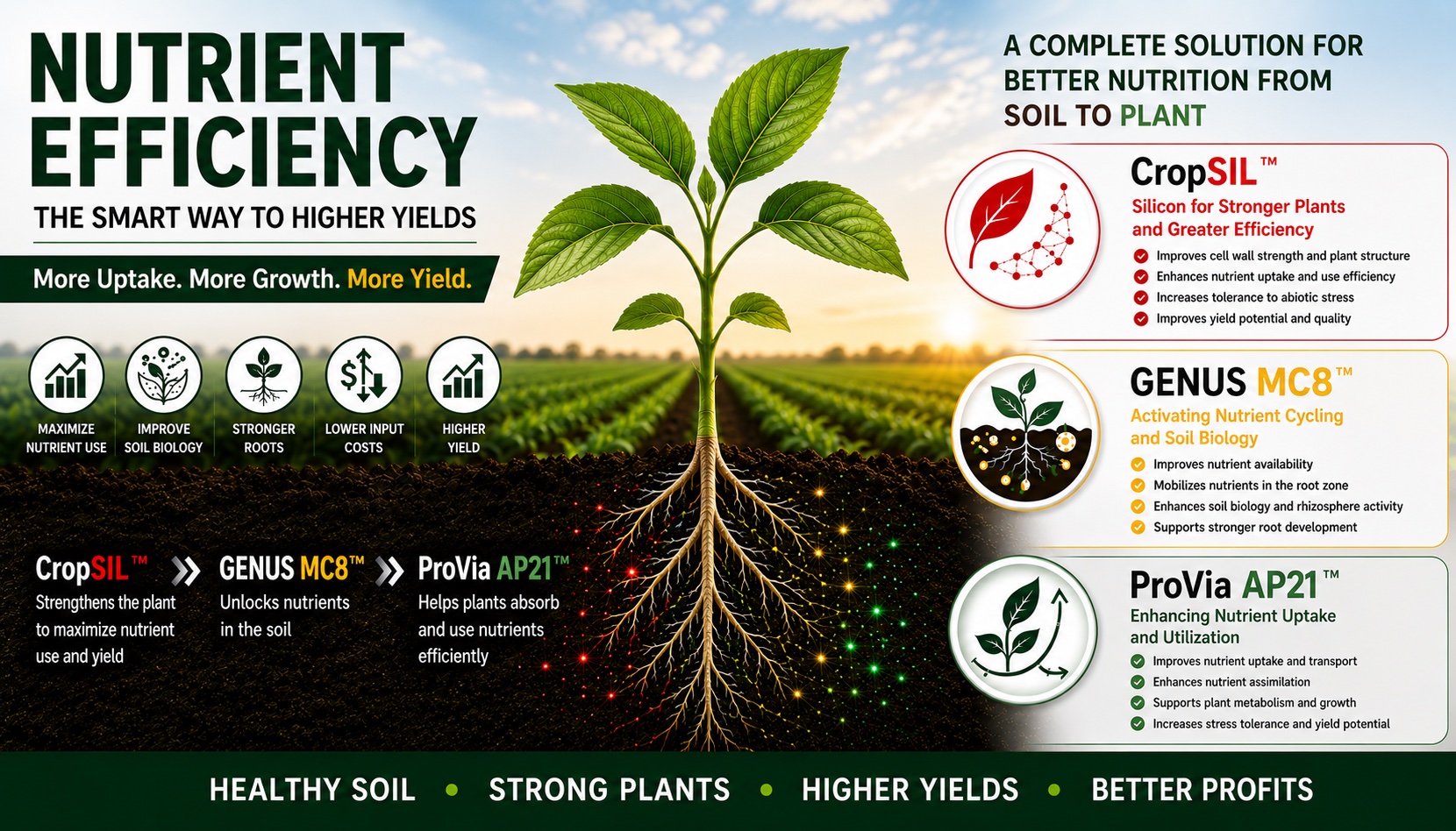
This is where GENUS MC8 and ProVia AP21 work together as a complementary nutrient-efficiency solution.
Strengthen Plants, Improve Crop Stress Resistance and Increase Crop Yield with Silicon Fertilizer-CropSIL®
Every farmer wants stronger, more productive crops that can withstand stress and deliver higher returns. CropSIL® is the scientifically proven advantage—a patented silicon-based plant nutrient enhancer that works at the cellular level to unlock your crop’s full genetic potential. Easy to use, highly effective, and compatible with your existing program.
CropSIL® is an advanced silicon-based plant nutrient enhancer and plant-available silicon fertilizer for agriculture designed to help farmers increase crop yield, strengthen plant structure, and improve resistance to drought, heat, and environmental stress.
It improves nutrient uptake efficiency, supports healthier plant growth, and enhances overall crop performance across a wide range of agricultural crops. Ideal for modern sustainable farming and high-yield crop production.
Beneficial Microbial Bio Fertilizer and Bio-stimulant For Nutrient Cycling and Soil Biology
GENUS MC8 is a beneficial microbial bio fertilizer and bio stimulant complex designed to improve nutrient availability through biological nutrient cycling.
Healthy soil contains billions of microorganisms that play a critical role in releasing nutrients and making them available to crops. However, intensive farming practices, soil degradation, and environmental stress can reduce microbial activity and limit nutrient availability.
GENUS MC8 introduces beneficial microorganisms that help:
- Improve biological nutrient cycling
- Mobilize nutrients within the soil
- Increase nutrient availability in the root zone
- Enhance rhizosphere activity
- Support healthy root development
- Improve soil biological function
By increasing nutrient availability in the soil, GENUS MC8 helps crops access nutrients that might otherwise remain unavailable. In simple terms, GENUS MC8 helps unlock the nutrients already present in the soil and fertilizer program.
Enhancing Nutrient Uptake and Utilization
With ProVia AP21
While nutrient availability is important, nutrients must also be efficiently absorbed and utilized by the plant. ProVia AP21 is a protein hydrolysate biostimulant formulated with plant-derived amino acids, bioactive peptides, and plant-available organic nitrogen (5-0-0).
The technology is designed to support plant metabolism and improve nutrient efficiency within the crop.
ProVia AP21 helps:
- Improve nutrient uptake by roots and foliage
- Enhance nutrient transport within the plant
- Improve nutrient assimilation and utilization
- Support plant metabolic activity
- Promote vigorous crop growth
- Improve tolerance to environmental stress
By enhancing the plant’s ability to absorb and utilize nutrients, ProVia AP21 helps maximize the effectiveness of existing fertility programs and improve overall crop performance.




CropSIL®, GENUS MC8 and ProVia AP21 Work Together to Improve Crop Nutrient Efficiency and Crop Yield
CropSIL® is a plant-available silicon fertilizer for agriculture designed to improve crop strength, yield potential, and stress tolerance. Unlike traditional fertilizers, CropSIL® works as a plant strength enhancer and biostimulant, helping crops grow stronger cell structures and improve resistance against environmental stress.
It is widely used in modern farming systems to:
- increase crop yield naturally
- improve plant vigor and strength
- enhance nutrient absorption efficiency
One of the most common causes of poor nutrient efficiency is a disconnect between nutrient availability and nutrient utilization. A crop cannot absorb nutrients that are unavailable in the soil, and available nutrients provide limited benefit if the plant cannot efficiently utilize them.
GENUS MC8 and ProVia AP21 address both sides of this challenge.
GENUS MC8 Helps Make Nutrients Available
Through beneficial microbial activity, GENUS MC8 supports biological nutrient cycling and helps increase nutrient availability in the rhizosphere.
This creates a more nutrient-rich environment around the root system.
ProVia AP21 Helps Plants Use Those Nutrients More Efficiently
Once nutrients become available, ProVia AP21 helps support nutrient uptake, transport, and assimilation within the plant.
This allows crops to convert available nutrients into plant growth, crop development, and yield more efficiently.
A Complete Nutrient Efficiency Strategy
Together, these technologies provide a comprehensive approach to nutrient efficiency:
| GENUS MC8 | ProVia AP21 |
|---|---|
| Improves nutrient availability | Improves nutrient uptake |
| Activates soil biology | Enhances nutrient transport |
| Supports nutrient cycling | Improves nutrient assimilation |
| Improves rhizosphere activity | Supports plant metabolism |
| Enhances root-zone function | Improves stress resilience |
The result is a more efficient use of nutrients, improved crop performance, stronger plant growth, and greater return on fertilizer investment.
- Learn more about How to Increase Crop Yield Naturally.
- Learn more about How Silicon Fertilizer Increases Crop Yield.
- Learn more about How to Improve Soil Health Naturally.
- Learn more about How to Improve Plant Nutrient Efficiency Naturally.
- Learn more about How to Fix Hard Soil Compacted Farmland and Regenerate Soil.
- Learn more about The Secret to Increasing Crop Yields: Stronger Roots and better crop stress resistance


Ready to Improve Nutrient Efficiency on Your Farm?
If you are looking to maximize fertilizer performance, improve nutrient availability, and increase nutrient uptake, Nuviatec offers an integrated biological solution through GENUS MC8 and ProVia AP21.
Together, these technologies help create a more efficient nutrient delivery system—from the soil to the plant—allowing growers to improve nutrient use efficiency, support healthier crops, and maximize yield potential.
Contact Nuviatec today to learn how CropSIL®, GENUS MC8 and ProVia AP21 can help unlock more value from your fertility program and improve crop productivity sustainably.
- [Contact Our Agronomy Team]
- [View Field Trial Results]
- [Explore Soil Regeneration Solutions]
- [Request Samples / Inquiry Form]
Contact Us
By phone: (416) 900-3768
By email: info@nuviachem.com