
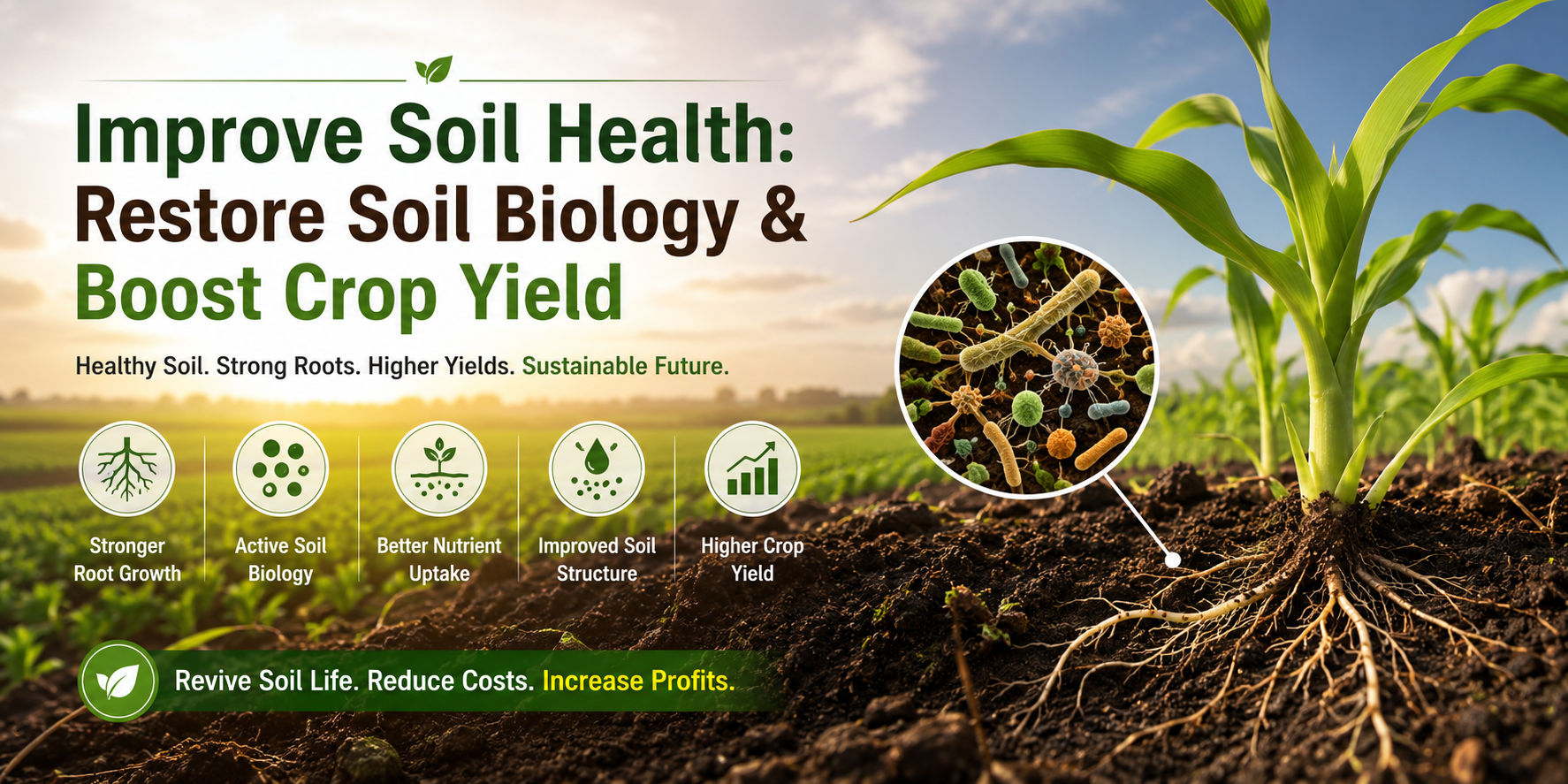
Improve Soil Health Naturally: How Farmers Can Regenerate Soil Biology and Increase Crop Yield
Healthy soil is the foundation of productive and profitable farming. However, many farmers today are facing declining soil fertility, increasing fertilizer costs, poor nutrient uptake, and inconsistent crop performance. Years of intensive farming, continuous cropping, soil compaction, and reduced organic matter have weakened the natural biological activity that keeps soil productive. To improve soil health and achieve sustainable crop production, farmers must focus on restoring the living organisms that drive nutrient cycling and root development. By learning how to regenerate soil biology, improve soil structure, and support beneficial soil microbes, growers can increase crop yield, improve fertilizer efficiency, and build healthier soils for long-term farming success. In this article, we explore the causes of declining soil health and practical strategies farmers can use to restore soil function naturally and sustainably.
Improve Soil Health in Modern Farming and Why It Is Declining
Healthy soil is the foundation of successful farming, yet many growers are noticing that their fields are not performing as well as they did years ago. Despite applying more fertilizer and investing more money into crop production, yields often remain stagnant or become increasingly inconsistent. This trend is occurring across many agricultural regions and is largely connected to declining soil health.
Modern farming practices have significantly increased food production, but they have also placed tremendous pressure on the soil. Continuous cropping, intensive tillage, soil erosion, compaction from heavy machinery, and limited organic matter return have gradually reduced the soil’s natural ability to support crop growth. As a result, soils lose structure, water-holding capacity, biological activity, and nutrient efficiency.
When soil health declines, farmers often experience a cycle of increasing input costs. More fertilizer is required to achieve the same results, irrigation becomes less efficient, and crops become more vulnerable to drought stress and environmental pressures. Over time, the soil becomes less resilient and less productive.
Improving soil health is not simply about adding nutrients. It involves rebuilding the physical, chemical, and biological properties of soil so that it can function as a healthy, living ecosystem. Understanding why soil health is declining is the first step toward restoring long-term productivity and profitability on the farm.
Increase Soil Fertility by Understanding Soil Biology Loss
Many farmers think soil fertility is determined only by the amount of fertilizer applied to the field. While nutrients such as nitrogen, phosphorus, and potassium are important, true soil fertility depends on much more than nutrient levels alone. A healthy and fertile soil contains a diverse community of microorganisms that continuously recycle nutrients and make them available to crops.
Over time, intensive farming practices can reduce the diversity and population of beneficial soil organisms. When microbial activity declines, nutrients become less available to plants, even when fertilizers are present in the soil. This often results in reduced nutrient-use efficiency and lower crop performance.
Soil biology plays a critical role in breaking down crop residues, converting organic matter into plant-available nutrients, and supporting healthy root systems. Without these biological processes, soil gradually loses its natural fertility and becomes increasingly dependent on external inputs.
Farmers who want to increase soil fertility should focus not only on supplying nutrients but also on restoring the biological activity that drives nutrient cycling. Healthy soil biology creates a more balanced and efficient soil ecosystem that supports stronger crop growth and long-term productivity.
Regenerate Soil Biology to Restore Natural Soil Function
Soil biology is often referred to as the engine of the soil ecosystem. Billions of bacteria, fungi, and other microorganisms work together to support nutrient cycling, improve soil structure, and maintain overall soil health.
When soil biology is damaged, many natural processes begin to slow down. Organic matter decomposition becomes less efficient, nutrient release is reduced, and beneficial relationships between roots and microorganisms are weakened. As a result, crops may struggle to access the nutrients they need for optimal growth.
To regenerate soil biology, farmers must create conditions that support microbial activity. This includes increasing organic matter levels, minimizing unnecessary soil disturbance, improving soil structure, and providing an environment where beneficial microbes can thrive.
As soil biology recovers, farmers often notice improvements in root growth, nutrient availability, moisture retention, and crop vigor. Regenerating soil biology is one of the most effective long-term strategies for improving farm productivity while reducing reliance on high-input farming practices.
Improve Soil Structure for Better Root Development and Water Flow
Soil structure refers to the arrangement of soil particles and the spaces between them. Good soil structure allows water, air, and roots to move freely throughout the soil profile. Poor soil structure, on the other hand, can limit root development and reduce crop performance.
Compacted soils are a common problem in modern agriculture. Heavy equipment, repeated tillage, and insufficient organic matter can cause soil particles to become tightly packed together. This reduces pore space and restricts the movement of water and oxygen.
When roots encounter compacted soil layers, they often remain shallow and poorly developed. Shallow root systems are less effective at accessing nutrients and moisture, making crops more vulnerable to drought stress and nutrient deficiencies.
Improving soil structure creates a healthier environment for root growth. Better aggregation, increased pore space, and improved water infiltration help crops establish stronger root systems that can support higher yields and greater resilience throughout the growing season.
Increase Crop Yield by Restoring Soil Microbial Activity
Higher yields begin below the soil surface. While weather, genetics, and management practices all influence crop performance, soil microbial activity plays a critical role in determining how effectively plants use available resources.
Beneficial microorganisms help convert nutrients into forms that plants can absorb more easily. They also support root development and improve the efficiency of nutrient uptake throughout the growing season.
When microbial populations are healthy and active, crops often demonstrate stronger early growth, improved stress tolerance, and more consistent performance. This creates conditions that support increased crop yield and improved profitability.
Rather than focusing solely on increasing fertilizer application rates, farmers can often achieve better results by improving the biological processes that help crops access nutrients already present in the soil. Restoring soil microbial activity is a practical strategy for improving productivity while supporting long-term soil health.
Improve Nutrient Uptake Efficiency Through Active Soil Biology
One of the biggest challenges in modern agriculture is nutrient loss. Fertilizers represent a major production cost, yet a significant portion of applied nutrients may never reach the crop.
Active soil biology helps improve nutrient uptake efficiency by converting nutrients into plant-available forms and transporting them throughout the root zone. Beneficial microorganisms work closely with plant roots to enhance nutrient absorption and improve overall nutrient-use efficiency.
Healthy microbial communities are particularly important for phosphorus availability, micronutrient uptake, and nitrogen cycling. These biological processes help ensure that nutrients remain accessible to crops throughout the growing season.
When nutrient uptake efficiency improves, farmers can often achieve better crop performance with more effective use of existing fertilizer programs. This not only supports higher yields but also contributes to lower input costs and improved environmental sustainability.
Reduce Fertilizer Cost by Improving Soil Health Naturally
Fertilizer expenses represent one of the largest operating costs for many farms. As fertilizer prices continue to fluctuate, farmers are increasingly looking for ways to improve efficiency and reduce dependency on high application rates.
Healthy soils naturally recycle nutrients through biological activity and organic matter decomposition. When soil health improves, nutrients remain available to crops for longer periods and are utilized more efficiently.
Improved soil structure, stronger root systems, and active microbial populations all contribute to better fertilizer performance. Rather than relying solely on additional fertilizer applications, farmers can often achieve greater efficiency by improving the soil environment itself.
Over time, healthier soils may help reduce fertilizer losses, improve nutrient retention, and increase the return on every dollar invested in crop nutrition programs.
Restore Soil Microbial Activity for Sustainable Farming Systems
Sustainable farming begins with healthy soil. Long-term productivity depends on maintaining biological processes that support nutrient cycling, organic matter decomposition, and soil structure development.
Microbial activity serves as the foundation of these processes. When microbial populations are diverse and active, soils become more resilient to environmental stress and better able to support crop production year after year.
Restoring soil microbial activity can help improve soil function while reducing the need for excessive inputs. This creates a more balanced farming system that supports profitability and environmental stewardship at the same time.
As agriculture continues to evolve, maintaining healthy soil biology will remain one of the most important strategies for achieving sustainable crop production and long-term farm success.
Improve Soil Organic Matter for Long-Term Soil Health
Organic matter is often considered one of the most important indicators of soil health. It serves as a food source for soil microorganisms, improves soil structure, and enhances the soil’s ability to retain water and nutrients.
Unfortunately, many agricultural soils have experienced declining organic matter levels due to intensive cultivation and limited organic residue return. As organic matter decreases, soils become more susceptible to compaction, erosion, and nutrient loss.
Increasing soil organic matter provides numerous benefits. It improves water-holding capacity, supports microbial activity, enhances nutrient availability, and contributes to better soil aggregation.
Building organic matter is a long-term process, but the benefits can be substantial. Farmers who invest in improving soil organic matter are often rewarded with healthier soils, stronger crops, and greater productivity over time.



Sustainable Farming Soil Health and Long-Term Yield Stability
Improving soil health is one of the most important investments farmers can make for the future of their operations. Healthy soils support stronger root systems, improve nutrient uptake, increase water-holding capacity, and help crops perform more consistently under changing growing conditions. As soil biology declines, farmers often experience increasing fertilizer costs, lower nutrient-use efficiency, soil compaction, and reduced yield potential.
The good news is that soil health can be restored. By focusing on regenerative soil management practices that increase biological activity, improve soil structure, and build organic matter, growers can gradually rebuild the natural processes that drive long-term productivity. Restoring soil biology not only improves soil fertility but also helps create a more resilient farming system capable of delivering sustainable crop yields year after year.
- Learn more about How to Increase Crop Yield Naturally.
- Learn more about How Silicon Fertilizer Increases Crop Yield.
- Learn more about How to Improve Soil Health Naturally.
- Learn more about How to Improve Plant Nutrient Efficiency Naturally.
- Learn more about How to Fix Hard Soil Compacted Farmland, and Regenerate Soil.
- Learn more about The Secret to Increasing Crop Yields: Stronger Roots and better crop stress resistance
EDAGUM®SM Bio Active Liquid Bio Fertilizer:
A Practical Solution to Regenerate Soil Biology
For farmers looking to accelerate soil regeneration and improve soil functionality, EDAGUM®SM Bio Active Liquid Bio Fertilizer offers a practical biological solution.
EDAGUM®SM is an advanced bio active soil amending complex developed to support soil regeneration by stimulating biological activity within the soil ecosystem. Rather than simply supplying nutrients, the technology works by enhancing the natural biological processes that improve nutrient cycling, soil aggregation, organic matter utilization, and root-zone development.
Key benefits of EDAGUM®SM include:
- Activates humification processes to help build long-term soil fertility
- Stimulates beneficial soil microflora and microbial activity
- Improves soil water-holding capacity and drought resilience
- Mobilizes plant-unavailable phosphorus already present in the soil
- Supports nutrient availability and nutrient-use efficiency
- Enhances soil structure and aggregation
- Helps support cleaner soils through heavy metal sequestration mechanisms
Because EDAGUM®SM works on the biological and physical properties of soil, it directly addresses many of the challenges discussed throughout this article, including declining soil fertility, reduced microbial activity, poor soil structure, low organic matter efficiency, and increasing fertilizer dependency. By supporting a healthier and more biologically active soil environment, EDAGUM®SM helps farmers rebuild the foundation of sustainable crop production.
Whether used during pre-plant soil preparation, throughout the growing season, or as part of a post-harvest soil regeneration program, EDAGUM®SM can be integrated into existing crop management systems to support long-term soil health and farm profitability. It is suitable for a wide range of crops and soil types and can also be used in organic agriculture programs.


Take the Next Step Toward Soil Health Improvement
If your farm is experiencing declining soil fertility, increasing fertilizer requirements, poor nutrient utilization, or reduced crop performance, it may be time to focus on rebuilding the biological foundation of your soil.
EDAGUM®SM Bio Active Liquid & Bio Fertilizer provides farmers with a science-based biological tool to help regenerate soil health, stimulate microbial activity, improve nutrient cycling, and support stronger crop performance for the long term. Healthy soil is not just an input—it is one of the most valuable assets on the farm.
Contact NuViaTec today to Discover how EDAGUM®SM and NuViaTec biological soil technologies can help regenerate soil health, improve nutrient efficiency, and support sustainable crop production and profitable farming.
- [Contact Our Agronomy Team]
- [View Field Trial Results]
- [Explore Soil Regeneration Solutions]
- [Request Samples / Inquiry Form]
Contact Us
By phone: (416) 900-3768
By email: info@nuviachem.com or info@nuviatec.com